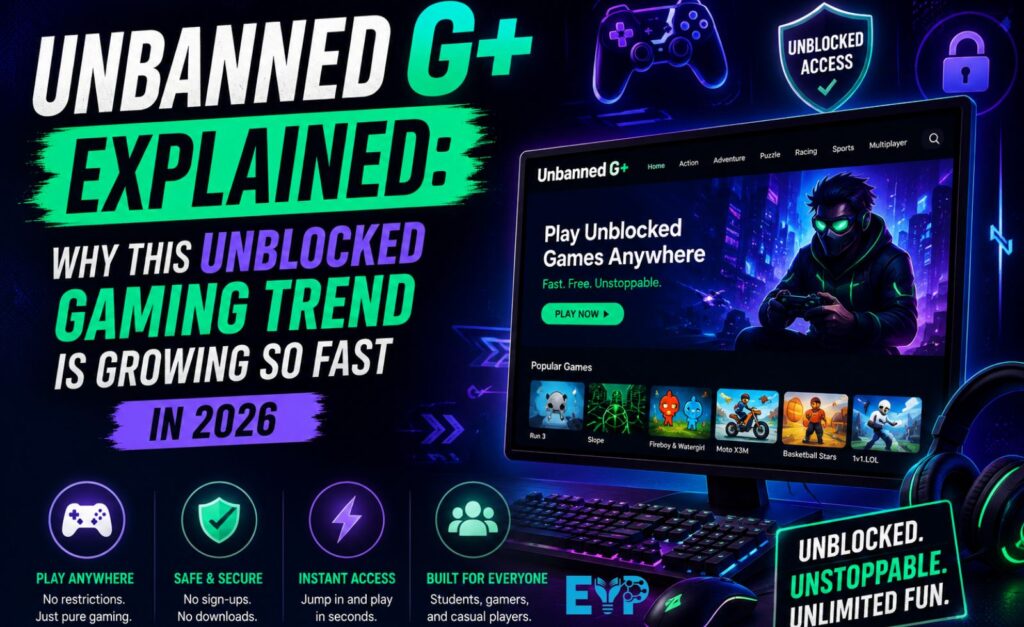
The internet has a funny way of creating things that don’t really “exist” in the traditional sense, yet still explode in popularity. Unbanned G+ is one of those cases. It’s not a company. It’s not a single website. And it’s definitely not an official platform backed by Google.
So why does it keep showing up everywhere in search engines, school conversations, and gaming communities?
Because it represents something bigger than itself a fast-moving unblocked gaming trend built on access, curiosity, and digital workarounds inside restricted environments like school Wi-Fi networks and Chromebooks.
Let’s break it down properly, without myths or hype.
Unbanned G+ Explained: What It Actually Is (And What It Isn’t)
At its core, Unbanned G+ is not a product. It’s a search-driven label used across multiple unblocked games sites, often created to attract traffic from students searching for free browser games unblocked.
There’s no central platform behind it. Instead, you’ll find different gaming hubs, mirror pages, and clones using similar branding like Unblocked Games G+ or Unbanned G Plus.
Most of these sites rely on HTML5 browser technology and simple browser-based access, meaning games run directly inside a browser without installation. That’s why they show up so often in restricted environments like educational networks.
Here’s the important distinction:
- It’s not Google+
- It’s not an official gaming service
- It’s a shifting ecosystem of browser-based games
Think of it like a digital “nickname” that different sites borrow to get discovered.
Why the Name “Unbanned G+” Went Viral
The name itself is part of the story. It didn’t come from branding experts. It came from search behavior and SEO-driven trends.
The “G+” suffix creates confusion with Google+, which helps curiosity-driven clicks. Combine that with words like “unbanned” or “unblocked,” and you get a perfect storm for organic search traffic.
Many site owners intentionally use keyword variations to capture users searching for:
- what is unbanned g+
- unblocked games g+
- browser games on restricted networks
This is classic search keyword ecosystem behavior. The name spreads not because it’s meaningful, but because it performs well in search engines.
Over time, it turned into a viral internet culture signal, especially among students and browser gamers looking for quick access during breaks.
How Unbanned G+ Actually Works Behind the Scenes
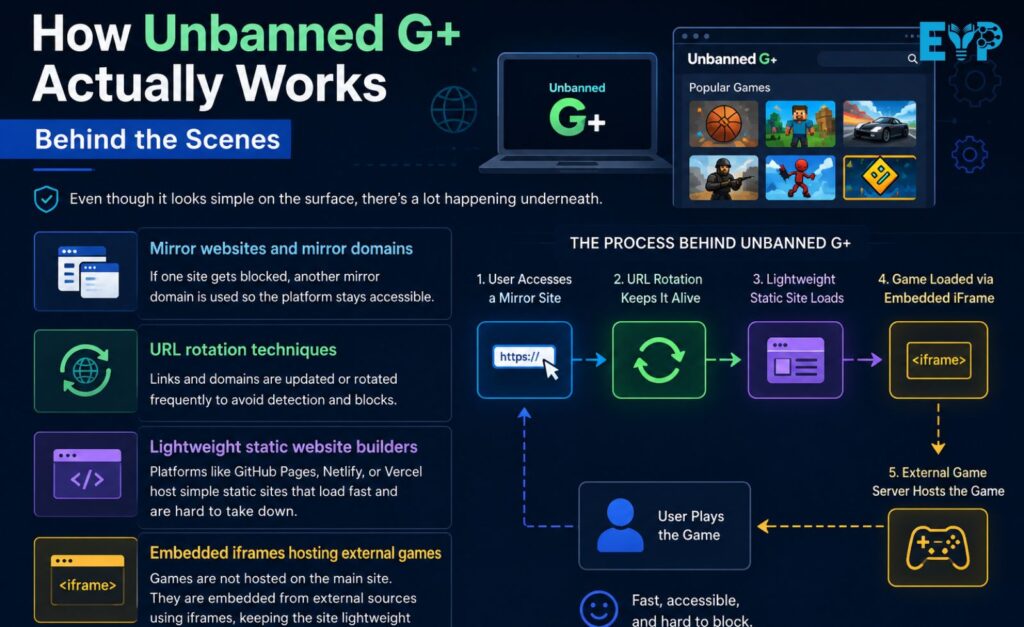
Even though it looks simple on the surface, there’s a lot happening underneath.
Most Unbanned G+ game hubs rely on:
- Mirror websites and mirror domains
- URL rotation techniques
- Lightweight static website builders
- Embedded iframes hosting external games
These setups let site owners move content quickly when a domain gets blocked. That’s why links often change or disappear.
Many games are hosted using HTML5 browser games, which makes them extremely portable. No downloads. No installations. Just click and play.
Some platforms even rely on Google-hosted pages or shared hosting environments to reduce costs and increase uptime.
But here’s the catch: this ecosystem is unstable. Because of network filtering and content blocking, these sites often get moved, duplicated, or replaced.
Where the Unbanned G+ Trend Came From
The roots go back to early unblocked gaming sites designed for school environments.
As Chromebooks became common in classrooms, students started looking for ways to access browser games on restricted networks. That demand created a wave of lightweight gaming websites.
These sites spread through:
- Student forums
- Social sharing in classrooms
- Discord and group chats
- Search-driven discovery
The result? A self-sustaining gaming ecosystem built around restriction and access.
The more schools tightened network restrictions, the more creative users became with finding alternatives.
Why Unbanned G+ Is Growing So Fast
The growth of Unbanned G+ isn’t random. It follows clear patterns in user behavior and digital accessibility demand.
Let’s break it down in a realistic way.
1. Works in Restricted Networks
Most school systems rely on content filtering rather than deep inspection. That means lightweight gaming sites can slip through until they’re flagged.
This creates a constant push-and-pull between blocked websites and new mirror versions.
2. No Installation Required
Users don’t want friction. They want instant access.
That’s why browser-based games dominate this space. No downloads. No permissions. Just open and play.
This “zero friction experience” is a major driver of adoption.
3. Lightweight Performance Design
Many of these platforms use HTML5 browser technology optimized for low-end devices.
That makes them perfect for:
- School laptops
- Chromebooks
- Office computers
Even with limited hardware, lightweight browser games still run smoothly.
4. Viral Sharing Loops
The growth of Unbanned G+ heavily depends on viral sharing.
One working link gets passed around quickly. Then it gets copied. Then mirrored. Then replaced.
This creates a cycle of user-generated discovery that keeps the trend alive.
5. Short-Session Gaming Fit
These platforms are designed for quick breaks, not long sessions.
Most games fall into categories like:
- Arcade Games
- Puzzle Games
- Racing Games
- Idle Games
This aligns perfectly with quick entertainment consumption habits.
What Types of Games Are Typically Found on Unbanned G+
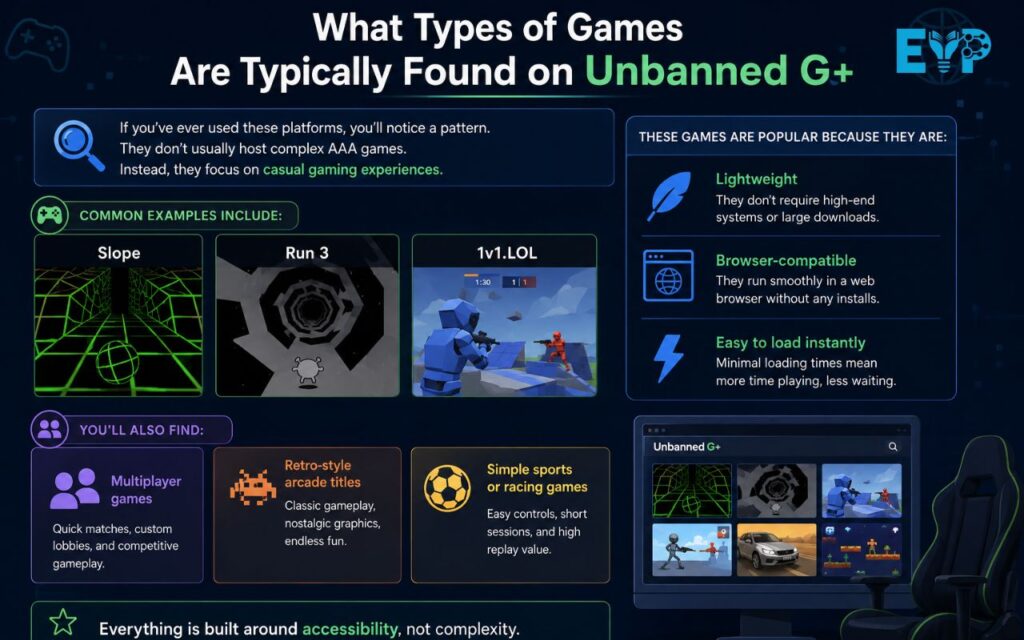
If you’ve ever used these platforms, you’ll notice a pattern.
They don’t usually host complex AAA games. Instead, they focus on casual gaming experiences.
Common examples include:
- Slope
- Run 3
- 1v1.LOL
These games are popular because they are:
- Lightweight
- Browser-compatible
- Easy to load instantly
You’ll also find:
- Multiplayer games
- Retro-style arcade titles
- Simple sports or racing games
Everything is built around accessibility, not complexity.
Why Students Specifically Search for Unbanned G+
The keyword surge isn’t accidental. It reflects real user demand in restricted educational environments.
Students often deal with:
- Strict school internet policies
- Blocked entertainment websites
- Limited device permissions on Chromebooks
So they turn to search engines with queries like:
- unblocked games for school
- games not blocked on chromebook
- browser games without downloads
The intent is simple: quick access during downtime.
And because search engines respond to that demand, the search traffic keeps growing.
The SEO and Internet Culture Behind the Name
This is where things get interesting.
The rise of Unbanned G+ is deeply tied to SEO strategy and search optimization.
Many websites intentionally:
- Stuff keyword variations
- Use trending labels
- Target organic search growth
It’s not just gaming—it’s search-driven discovery.
At the same time, internet culture plays a role. Students remix names, share links, and turn them into micro-trends inside their communities.
This blend of SEO + internet culture creates a powerful loop:
- Search demand increases
- More sites appear
- More clones spread
- Trend becomes self-reinforcing
Is Unbanned G+ Safe to Use? A Realistic Breakdown
Safety depends on where you land.
Some sites are harmless. Others aren’t.
What Appears Safe
Most platforms don’t require login or personal data. That reduces risk on the surface.
They also run directly in browsers, which avoids software installation.
Hidden Risks You Should Know
This is where users need caution.
Some risks include:
- Malicious ads
- Fake download prompts
- Phishing redirects
- Data tracking scripts
Because these sites often rely on unstable hosting, they don’t always follow strict cybersecurity standards.
How to Stay Safer Online
If you explore these platforms, keep it simple:
- Use safe browsing tools
- Avoid clicking suspicious ads
- Don’t download anything
- Stick to known gaming platforms when possible
A little awareness goes a long way.
The Biggest Misconception : Is It Related to Google+?
No, it isn’t.
Even though the “G+” name suggests a link to Google, there is no connection to Google or Google+ at all.
The similarity is purely accidental and often used to boost curiosity in search results.
It’s a branding trick more than anything else.
Pros and Cons of Unbanned G+ Platforms
Let’s keep this balanced.
Pros
- Instant browser access
- No installation required
- Works on most devices
- Wide variety of casual games
Cons
- Frequent domain changes
- Exposure to malicious ads
- Inconsistent quality
- Weak security standards
Alternatives to Unbanned G+ (Better and Safer Options)
If you want stability, there are better choices.
Look for:
- Verified browser-based gaming platforms
- Official app stores with offline games
- Educational game portals approved for schools
These offer more consistent safe browsing and fewer risks.
They may not feel as “hidden,” but they’re far more reliable.
Why These Platforms Keep Changing or Disappearing
This instability is part of the ecosystem.
Main reasons include:
- Domain switching after blocks
- Hosting limitations
- Copycat competition
- Lack of centralized ownership
Think of it like a moving target inside the internet.
Once one version disappears, another replaces it.
The Future of Unbanned G+ and Unblocked Gaming Ecosystems
The future isn’t about one platform. It’s about evolution.
We’re likely to see:
- More decentralized browser game hubs
- Stronger network filtering systems in schools
- Growth of mobile-first casual gaming
- Better regulation of web-based entertainment
At the same time, demand for instant access won’t disappear.
As long as users want quick entertainment, unblocked gaming trends will continue to evolve.
What Unbanned G+ Really Represents in Internet Culture
Beyond games, this trend reflects something deeper.
It shows the constant tension between:
- Restriction vs accessibility
- Control vs creativity
- Filtering vs discovery
It also highlights how users adapt to digital environments. When access is limited, people find workarounds.
In a way, Unbanned G+ is less about gaming and more about behavior. It represents how internet users respond when systems don’t fully match their needs.
And that’s why it keeps growing.
Final Thoughts
Unbanned G+ isn’t a single destination. It’s a reflection of how modern browser-based gaming ecosystems evolve under restriction, curiosity, and search-driven demand.
It sits at the intersection of SEO trends, student behavior, and lightweight web technology, making it one of the more interesting micro-trends in today’s internet culture.
And like most digital trends built on access and curiosity, it won’t disappear anytime soon it will just keep changing shape.

Muhammad Bilal is an expert blogger specializing in meanings in text, delivering clear, engaging insights that help readers understand modern language, slang, and digital communication trends.