
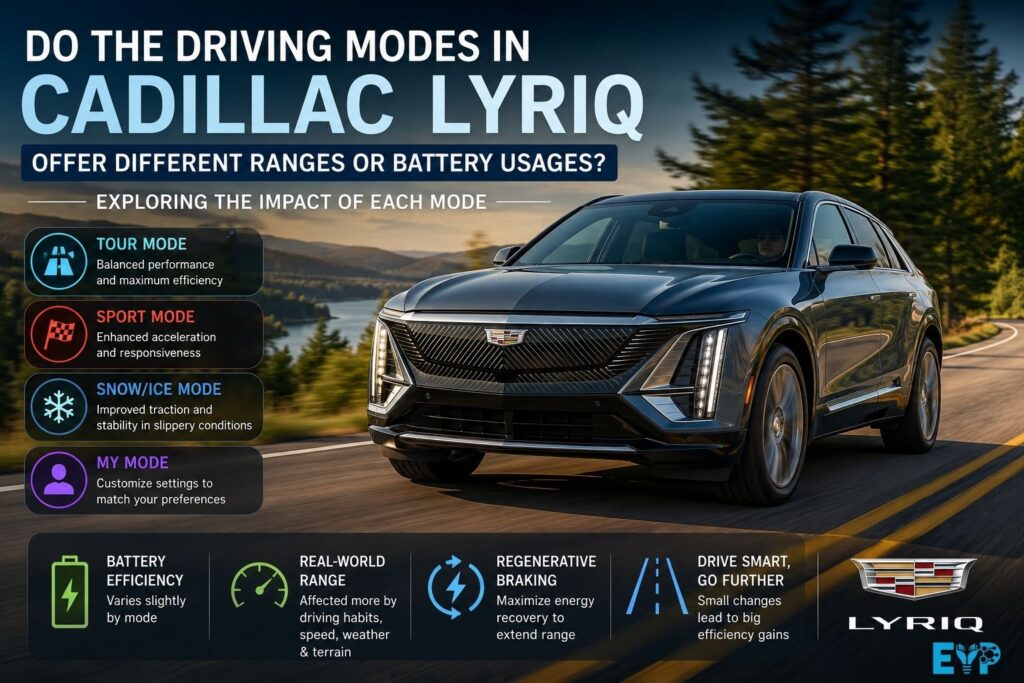
If you’ve spent any time behind the wheel of a Cadillac LYRIQ, you’ve probably noticed the different driving modes available through the Driver Mode Control system. With options like Tour Mode, Sport Mode, Snow/Ice Mode, and My Mode, it’s easy to assume that each setting changes how much battery the SUV uses.
That leads to a common question: Do the Driving Modes in Cadillac LYRIQ Offer Different Ranges or Battery Usages?
The answer is a little more nuanced than a simple yes or no.
Driving modes don’t change the size of the battery or unlock hidden capacity. Instead, they modify how the vehicle responds to your inputs. Things like throttle response, steering feel, torque delivery, and traction control all change depending on the selected mode. Those adjustments can influence how you drive, which is where differences in Cadillac LYRIQ battery usage and Cadillac LYRIQ range begin to appear.
Think of it like wearing different pairs of running shoes. Your body doesn’t suddenly gain or lose energy. However, the shoes can encourage you to run faster, slower, or more comfortably. The same principle applies to this luxury electric SUV.
In this guide, you’ll learn exactly how each driving mode works, whether it affects energy efficiency, and which factors actually have the biggest impact on real-world range.
How Cadillac LYRIQ Driving Modes Work
Modern Electric Vehicle (EV) technology relies heavily on software. Unlike traditional gasoline vehicles that adjust engine behavior mechanically, the Cadillac LYRIQ uses intelligent programming to tailor the driving experience.
When you change driving modes, you’re not altering the Ultium battery platform, increasing battery capacity, or limiting available energy. Instead, you’re changing how the vehicle delivers that energy through its electric powertrain.
Several systems work together behind the scenes whenever you select a different mode. These include:
- Accelerator mapping
- Power delivery
- Torque delivery
- Steering feel
- Traction control
- Wheel slip prevention
- Overall driving dynamics
The result is a vehicle that feels noticeably different without physically changing its battery.
What Is a Driving Mode in an Electric Vehicle?
A driving mode is essentially a collection of software settings that changes how responsive your vehicle feels.
For example, pressing the accelerator halfway in Sport Mode may produce quicker acceleration than pressing it halfway in Tour Mode. The battery isn’t providing extra electricity because of the mode itself. Instead, the software allows the motors to respond more aggressively to the same pedal input.
That’s why many EV owners mistakenly believe one mode “uses more battery.” In reality, the driver’s behavior usually changes alongside the selected mode.
This distinction is important because does driving mode affect EV battery consumption isn’t really about the battery. It’s about how much energy the driver requests from the vehicle.
Does Changing Driving Modes Change Battery Capacity?
The short answer is no.
Every Cadillac LYRIQ has a fixed battery pack with a defined kilowatt-hour (kWh) capacity. Switching between modes doesn’t increase or decrease the amount of stored energy available.
Instead, driving modes influence how efficiently that stored energy is used.
Here’s the difference:
| Term | What It Means |
|---|---|
| Battery Capacity | Total energy stored inside the battery pack. |
| Energy Consumption | How quickly the vehicle uses that stored energy. |
| Driving Range | The estimated distance you can travel before recharging. |
| Energy Efficiency | How effectively the vehicle converts battery power into miles traveled. |
Understanding this difference clears up one of the biggest myths surrounding Cadillac LYRIQ battery performance.
Overview of Cadillac LYRIQ Driving Modes

Each driving mode serves a specific purpose. Rather than chasing maximum range, Cadillac designed these settings to adapt the SUV to different road conditions and driving preferences.
Let’s look at what each one actually does.
Cadillac LYRIQ Tour Mode
Cadillac LYRIQ Tour Mode is the default setting that most drivers will use every day.
It balances comfort, responsiveness, and vehicle efficiency without making the SUV feel sluggish. Acceleration remains smooth, steering effort feels natural, and power delivery is predictable whether you’re navigating city streets or cruising on the highway.
Because Tour Mode encourages gradual acceleration, many drivers naturally achieve better Cadillac LYRIQ driving efficiency while using it. That’s not because the software magically saves electricity. Instead, the vehicle simply makes smooth driving easier.
For daily commuting, grocery runs, and long-distance travel, Tour Mode provides an excellent balance between comfort and efficiency.
Cadillac LYRIQ Sport Mode
Cadillac LYRIQ Sport Mode changes the SUV’s personality almost immediately.
Throttle inputs become sharper, acceleration feels more immediate, and steering typically gains additional weight to create a more engaging driving experience. The vehicle responds faster to pedal movements, allowing the electric motor to deliver its impressive instant torque more aggressively.
Many people assume Does Sport Mode reduce range in Cadillac LYRIQ? The answer depends less on the mode itself and more on how you drive while using it.
If you frequently accelerate hard, merge aggressively, or enjoy rapid launches from stoplights, battery consumption will naturally increase. Higher power demand requires more energy from the battery, which reduces overall efficiency.
On the other hand, if you drive calmly while Sport Mode is selected, the difference in Cadillac LYRIQ EV range may be surprisingly small.
Cadillac LYRIQ Snow/Ice Mode
Slippery roads demand a completely different approach to power delivery.
That’s exactly why Cadillac LYRIQ Snow/Ice Mode exists.
Instead of maximizing responsiveness, this mode softens accelerator inputs and works closely with the vehicle’s traction control system to minimize wheel slip prevention. Power reaches the wheels more gradually, making it easier to maintain grip on snow-covered or icy roads.
This isn’t an efficiency mode.
It’s a safety mode.
Many drivers ask, Does Snow/Ice Mode use more battery power? Under normal conditions, the mode itself doesn’t significantly increase electricity usage. However, winter driving often reduces Cadillac LYRIQ battery range because cold temperatures affect battery chemistry while cabin heating, window defrosters, and poor road conditions increase overall energy consumption.
In other words, winter conditions not Snow/Ice Mode usually account for most range loss.
Cadillac LYRIQ My Mode
Not every driver wants the same experience behind the wheel.
That’s where Cadillac LYRIQ My Mode becomes useful.
Rather than forcing you into preset characteristics, My Mode allows you to personalize elements such as steering feel and accelerator response. Depending on your preferences, you can create a setup that feels more comfortable, more responsive, or somewhere in between.
Naturally, many owners wonder, How My Mode affects Cadillac LYRIQ battery usage.
The answer depends entirely on your chosen settings and driving habits. A customized setup that mimics Sport Mode can encourage higher energy use, while one that favors smoother acceleration may help maintain consistent real-world efficiency.
The customization itself doesn’t consume extra electricity. Your driving style remains the deciding factor.
Do Cadillac LYRIQ Driving Modes Affect Driving Range?
This is the question nearly every new owner asks after exploring the infotainment system.
The simple answer is that driving modes influence how the vehicle behaves, not how much energy the battery stores.
Still, that behavioral change can indirectly affect Cadillac LYRIQ battery usage because it often changes the way people drive.
Imagine handing two people the exact same vehicle. One accelerates gently, anticipates traffic, and coasts whenever possible. The other enjoys rapid acceleration at every green light.
Even if both drivers select the same mode, they’ll almost certainly see different Miles per kWh (mi/kWh) and different estimated range.
Driving mode shapes the experience. The driver shapes the outcome.
The Short Answer
If you’re looking for a straightforward explanation, here it is.
Changing between Tour Mode, Sport Mode, Snow/Ice Mode, and My Mode does not directly increase or decrease battery capacity.
Instead, each mode changes:
- Throttle response
- Vehicle responsiveness
- Steering characteristics
- Torque management
- Traction behavior
Those adjustments influence how much power you request from the electric powertrain, which can indirectly change overall energy efficiency.
This is why Cadillac LYRIQ driving modes explained for battery life often causes confusion. The battery isn’t behaving differently. The driver usually is.
Why Sport Mode Can Reduce Efficiency

One of the biggest misconceptions surrounding EVs is that Sport Mode automatically drains the battery.
It doesn’t.
What actually happens is much simpler.
Sport Mode makes acceleration feel effortless. Since the SUV reacts more quickly to pedal inputs, many drivers accelerate harder without even realizing it. Every strong launch requires more electrical power from the battery management system, increasing short-term battery drain.
Rapid acceleration also means the motors spend more time delivering maximum output instead of operating in their most efficient range.
Picture two identical road trips.
The first driver accelerates gently and reaches cruising speed gradually.
The second floors the accelerator after every stop.
Both use the same battery pack. Both travel the same distance. Yet the second driver will almost always consume more energy.
That’s why Sport Mode is often associated with lower efficiency even though the software itself isn’t wasting electricity.
Why Tour Mode Often Produces Better Efficiency
When people ask, Which Cadillac LYRIQ driving mode gives the best range, Tour Mode is usually the closest answer.
The keyword here is usually.
Its smoother accelerator calibration naturally encourages gentle starts and steady cruising. Those habits reduce unnecessary power demand and help the vehicle achieve stronger energy management over longer distances.
Tour Mode also feels more relaxed during everyday commuting. Since the SUV doesn’t urge you to accelerate aggressively, maintaining consistent efficiency becomes easier without feeling like you’re sacrificing performance.
For many owners, it’s the sweet spot between comfort and EV battery optimization.
Snow/Ice Mode and Energy Consumption
Driving on snow or ice changes everything.
Traction becomes the priority, and efficiency takes a back seat.
Snow/Ice Mode limits sudden torque delivery to reduce wheel spin. While this softer power delivery can prevent wasted energy from spinning tires, the harsh conditions themselves often require more electricity.
Cold batteries deliver less efficient performance, cabin heaters consume additional energy, and rolling resistance increases on snowy roads. Combined, these factors often lead to a noticeable drop in Cadillac LYRIQ real-world range by driving mode, even though the driving mode isn’t responsible for most of the loss.
Winter driving is simply more demanding for every electric vehicle.
Can My Mode Improve Efficiency?
Because My Mode is customizable, there isn’t one universal answer.
Drivers who configure smoother accelerator behavior often find it easier to maintain consistent speeds and avoid unnecessary bursts of power. Those habits can improve overall vehicle efficiency.
Others create a more performance-focused setup that reacts quickly to every pedal movement. In that case, battery consumption may increase simply because the vehicle encourages a more spirited driving style.
The important takeaway is this: My Mode doesn’t contain a hidden efficiency setting. It simply reflects the preferences you choose.
Comparing Cadillac LYRIQ Driving Modes and Their Effect on Efficiency
The table below summarizes what each mode actually changes and how it can influence Cadillac LYRIQ energy efficiency.
| Driving Mode | Throttle Response | Steering Feel | Primary Purpose | Typical Impact on Efficiency |
|---|---|---|---|---|
| Tour Mode | Smooth and balanced | Comfortable | Everyday driving | Usually the most consistent for daily efficiency |
| Sport Mode | Faster and more aggressive | Heavier and more responsive | Performance-focused driving | Can reduce efficiency if you accelerate aggressively |
| Snow/Ice Mode | Gentle and progressive | Stability-focused | Improving traction on slippery roads | Depends more on weather and road conditions than the mode itself |
| My Mode | User configurable | User configurable | Personalized driving experience | Varies based on selected settings and driving habits |
As you can see, no mode directly changes battery capacity or unlocks extra miles. Instead, each one influences how the SUV responds to your commands. In the next section, we’ll look beyond driving modes and explore the factors that have the biggest impact on Cadillac LYRIQ range, battery performance, and everyday efficiency.
What Actually Has the Biggest Impact on Cadillac LYRIQ Range?
If you’re trying to maximize Cadillac LYRIQ range, driving mode should be fairly low on your list of concerns. The reality is that several everyday factors have a much larger influence on energy consumption and battery efficiency than whether you’re in Tour or Sport Mode.
Think of driving mode as one small piece of a much bigger puzzle. The way you drive, the environment around you, and how you care for the vehicle all work together to determine your real-world range.
Driving Speed
Ask any experienced EV owner what hurts range the most, and you’ll probably hear the same answer: speed.
As your speed increases, aerodynamic drag rises dramatically. The faster your Cadillac LYRIQ moves, the harder the electric powertrain must work to push air out of the way. That extra effort requires more electricity from the battery pack.
Around town, where speeds are lower, the LYRIQ often delivers excellent energy efficiency. On the interstate, however, sustained speeds above 70 mph typically reduce Miles per kWh (mi/kWh) regardless of which driving mode you select.
If your goal is maximizing range during a road trip, maintaining a steady speed between 60–65 mph is generally more effective than changing drive modes.
Acceleration Habits
The accelerator pedal has more influence over Cadillac LYRIQ battery usage than the driving mode button ever will.
Smooth acceleration allows the motors to draw power gradually. Hard launches demand significantly more energy over a short period, increasing overall battery consumption.
Fortunately, EVs reward smooth driving. Even moderate improvements in driving habits can noticeably increase efficiency over hundreds of miles.
Imagine carrying a full cup of coffee without spilling it. That same smoothness behind the wheel often leads to better range.
Regenerative Braking
One of the biggest advantages of an Electric Vehicle (EV) is Cadillac LYRIQ regenerative braking.
Instead of wasting energy as heat during braking, the motors work in reverse to recover some of that energy and send it back into the battery. While regenerative braking can’t create free electricity, it can reduce overall energy consumption, especially during city driving.
The LYRIQ also offers features like One-Pedal Driving and Regen on Demand, allowing drivers to capture additional energy while slowing down.
Urban traffic often becomes surprisingly efficient because frequent deceleration creates more opportunities for energy recovery.
Outside Temperature
Weather plays a surprisingly large role in Cadillac LYRIQ battery performance.
Cold temperatures slow the chemical reactions inside lithium-ion batteries, making them less efficient. At the same time, cabin heating, heated seats, heated steering wheels, and windshield defrosters all require electricity.
It’s not unusual to see a 10–20% range reduction during particularly cold winter conditions.
Hot weather presents different challenges. While batteries generally perform better in warmth than extreme cold, air conditioning and battery cooling systems still consume additional energy.
This is why many owners notice seasonal changes in Cadillac LYRIQ EV range even when their driving habits stay the same.
Terrain and Elevation
Flat highways are much easier on an EV than steep mountain roads.
Climbing long hills requires additional power because gravity constantly works against the vehicle. The electric motor draws more energy to maintain speed, increasing overall battery drain.
The good news is that descending allows the LYRIQ to recover some of that energy through regenerative braking.
Although you’ll never recover 100% of the electricity used during a climb, regenerative braking helps improve overall energy management compared to conventional vehicles.
Tire Pressure and Wheel Choice
Many drivers overlook their tires, yet they directly affect vehicle efficiency.
Underinflated tires create more rolling resistance, forcing the vehicle to work harder. Even slightly low tire pressure can reduce overall efficiency over time.
Wheel size also matters. Larger wheels typically look sportier, but they often weigh more and may increase rolling resistance.
Keeping your tires properly inflated according to Cadillac’s recommendations is one of the easiest ways to improve EV driving efficiency.
Vehicle Load
Extra weight always requires extra energy.
Passengers, luggage, sports equipment, and rooftop cargo carriers all increase the workload placed on the electric drivetrain.
The difference may seem small during short trips. Over hundreds of highway miles, however, additional weight can noticeably affect battery range.
Removing unnecessary cargo before a long trip won’t transform the vehicle, but every little improvement adds up.
Does Sport Mode Damage the Battery?
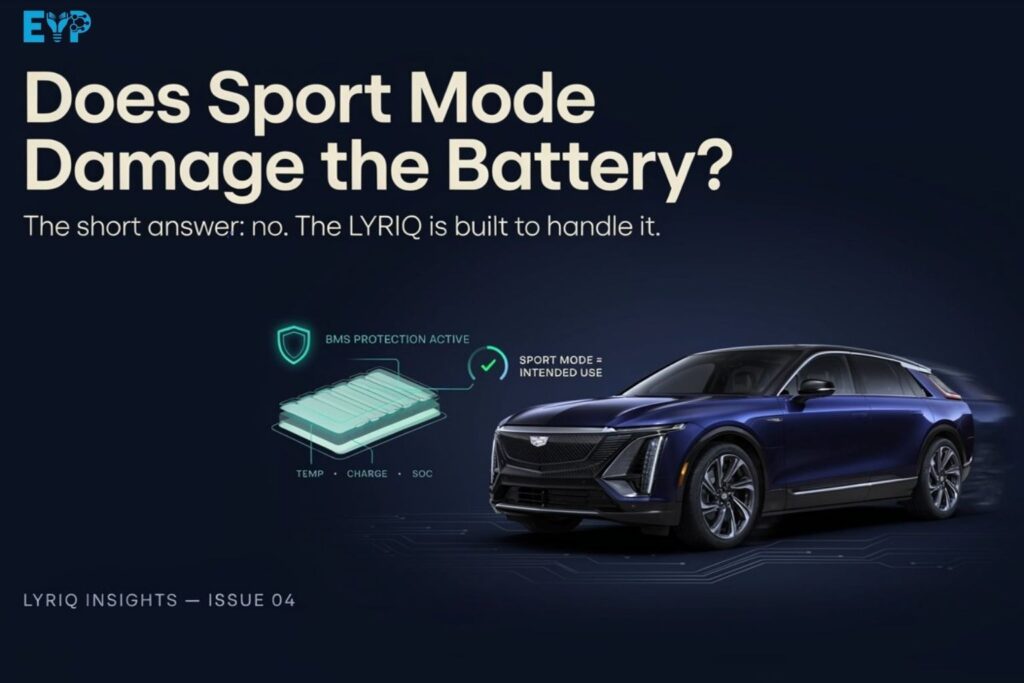
Another common concern among new EV owners is whether frequently using Cadillac LYRIQ Sport Mode harms the battery.
The good news is that normal use doesn’t damage the battery.
Cadillac designed the LYRIQ with sophisticated protection systems that continuously monitor battery temperature, charging speed, and State of Charge (SoC). The Battery Management System (BMS) automatically limits power whenever necessary to protect long-term battery health.
Using Sport Mode occasionally is no different than using extra horsepower in a gasoline vehicle. It’s part of the vehicle’s intended design.
Performance Doesn’t Equal Battery Damage
High acceleration briefly increases power demand, but the battery is engineered to handle it.
Modern EV batteries routinely experience changing loads during normal driving. Quick acceleration, highway merging, and climbing steep hills all require higher output, and the system accounts for these situations.
Unless you’re repeatedly pushing the vehicle under extreme conditions, Sport Mode alone isn’t something to worry about.
What Really Affects Battery Longevity
Long-term battery health depends much more on ownership habits than driving mode.
Some of the biggest factors include:
- Frequently relying on DC fast charging when Level 2 charging is available.
- Leaving the battery at 100% or near 0% for extended periods.
- Repeated exposure to extreme temperatures.
- Ignoring recommended software updates.
- Following poor charging routines over several years.
In other words, charging habits matter far more than whether you enjoy the occasional spirited drive.
Best Driving Mode for Different Situations
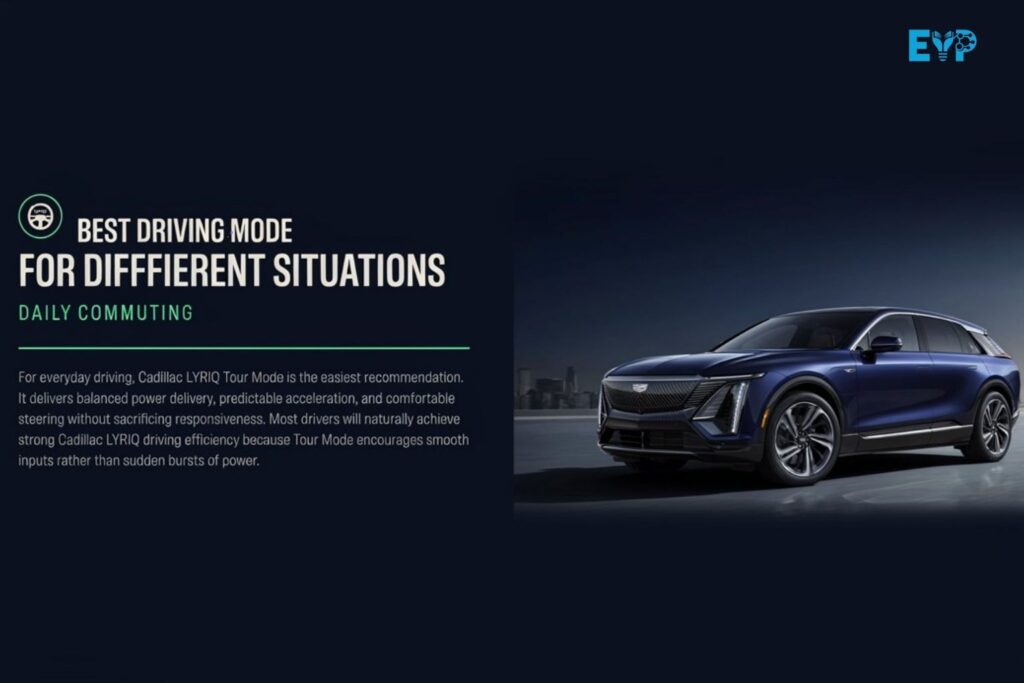
Rather than asking which mode is “best,” it’s more useful to ask which mode fits the situation.
Every setting was designed with a specific purpose in mind, so choosing the right one depends on where you’re driving and what kind of experience you want.
Daily Commuting
For everyday driving, Cadillac LYRIQ Tour Mode is the easiest recommendation.
It delivers balanced power delivery, predictable acceleration, and comfortable steering without sacrificing responsiveness. Most drivers will naturally achieve strong Cadillac LYRIQ driving efficiency because Tour Mode encourages smooth inputs rather than sudden bursts of power.
Highway Road Trips
Long highway drives reward consistency more than aggressive performance.
Tour Mode remains an excellent choice because maintaining a steady cruising speed contributes far more to efficiency than switching driving modes. Smooth acceleration and moderate highway speeds will have the biggest impact on your overall range.
Stop-and-Go City Traffic
City driving is where electric vehicles really shine.
Frequent slowing allows regenerative braking to recover energy that would otherwise be wasted. Using One-Pedal Driving whenever practical can increase energy recovery, helping improve efficiency during daily commutes and urban traffic.
Rain, Snow, and Ice
When road conditions become slippery, safety should always take priority over efficiency.
Cadillac LYRIQ Snow/Ice Mode softens torque delivery and improves traction by reducing wheel spin during acceleration. Although it won’t increase range, it can make winter driving much more predictable and confidence-inspiring.
Spirited Weekend Driving
Sometimes you simply want to enjoy everything the LYRIQ has to offer.
Sport Mode delivers quicker acceleration, sharper throttle response, and a more engaging feel behind the wheel. Just remember that spirited driving naturally increases battery consumption, regardless of the selected mode.
Maximizing Driving Range
If your goal is getting every possible mile from a full charge, combine these habits:
- Drive in Tour Mode.
- Accelerate gradually.
- Maintain moderate highway speeds.
- Make good use of One-Pedal Driving.
- Anticipate traffic instead of braking hard.
- Limit unnecessary climate control usage whenever possible.
Together, these habits will improve efficiency much more than simply changing drive modes.
Tips to Maximize Cadillac LYRIQ Range Regardless of Driving Mode
No matter which driving mode you prefer, these habits can help improve Cadillac LYRIQ energy efficiency.
| Tip | Why It Helps |
|---|---|
| Accelerate smoothly | Reduces unnecessary power demand |
| Maintain steady speeds | Improves highway efficiency |
| Use regenerative braking | Recovers energy during deceleration |
| Precondition the cabin while charging | Saves battery power before driving |
| Keep tires properly inflated | Reduces rolling resistance |
| Remove unnecessary cargo | Lowers energy consumption |
| Plan charging stops | Helps reduce range anxiety |
| Keep vehicle software updated | Ensures the latest efficiency improvements |
Small improvements may not seem dramatic during a single trip, but they can make a noticeable difference over months of ownership.
Common Misconceptions About Cadillac LYRIQ Driving Modes
Even as EV technology becomes more common, several myths continue to circulate.
“Sport Mode Automatically Uses More Battery”
Not exactly.
Sport Mode simply makes it easier to access the LYRIQ’s performance. If you drive gently, the difference in energy usage can be surprisingly small.
The driver’s right foot still has the biggest influence on efficiency.
“Tour Mode Always Gives the Best Range”
Usually—but not always.
Aggressive acceleration in Tour Mode can easily consume more energy than calm driving in Sport Mode. The selected mode matters less than the way you use it.
“Snow/Ice Mode Improves Efficiency”
Its purpose is traction, not battery savings.
If you notice lower range during winter, cold temperatures, increased HVAC usage, and reduced battery efficiency are usually the real reasons.
“My Mode Unlocks Extra Battery Range”
No.
Cadillac LYRIQ My Mode allows you to customize the driving experience, but it doesn’t increase battery capacity or unlock additional miles.
Frequently Asked Questions
Does Sport Mode reduce Cadillac LYRIQ range?
It can reduce range indirectly. Sport Mode encourages quicker acceleration, and aggressive driving increases energy consumption. However, calm driving in Sport Mode may produce results similar to Tour Mode.
Which Cadillac LYRIQ driving mode gives the best range?
For most drivers, Tour Mode delivers the most consistent balance between comfort, responsiveness, and efficiency.
Does Tour Mode improve battery efficiency in Cadillac LYRIQ?
Tour Mode doesn’t change the battery itself. It simply encourages smoother throttle response, which often helps drivers use less energy.
Does Snow/Ice Mode use more battery power?
Not by itself. Reduced winter range is usually caused by cold weather, cabin heating, and lower battery efficiency rather than the driving mode.
How does My Mode affect Cadillac LYRIQ battery usage?
It depends entirely on your settings and driving habits. A performance-oriented setup may encourage higher energy use, while smoother settings can help maintain efficiency.
Does driving mode affect EV battery consumption?
Yes, but only indirectly. Driving modes influence vehicle behavior, while the driver’s inputs ultimately determine how much electricity the vehicle consumes.
Is regenerative braking affected by driving mode?
Regenerative braking may feel slightly different depending on vehicle settings and features like One-Pedal Driving, but driving habits remain the biggest factor in overall energy recovery.
Conclusion
So, do the driving modes in Cadillac LYRIQ offer different ranges or battery usages? The technical answer is no. None of the available driving modes change the battery’s capacity, unlock additional stored energy, or directly increase Cadillac LYRIQ battery range.
What they do change is how the vehicle responds to your inputs. Tour Mode provides balanced performance for everyday driving, Sport Mode delivers quicker acceleration and sharper steering, Snow/Ice Mode improves traction in low-grip conditions, and My Mode lets you personalize the experience to suit your preferences.
In real-world driving, factors like speed, acceleration habits, weather, terrain, tire pressure, and effective use of regenerative braking have a much greater impact on Cadillac LYRIQ battery usage than the selected driving mode. Focus on efficient driving habits, choose the mode that matches your driving conditions, and you’ll get the best combination of performance, comfort, and range from your LYRIQ.

Muhammad Bilal is an expert blogger specializing in meanings in text, delivering clear, engaging insights that help readers understand modern language, slang, and digital communication trends.